In short: Publish a statistics page with 50+ numbers from original sources, each with a source and a date. Add your own data if you can, and keep the page updated.
Free backlinks are what you get when your page is the source of a number that someone else needs to print. No cold email, no form. A writer needs a figure, finds your statistics page, and links to it. ChatGPT works from sources too.
Download the Citation PDF WhatsApp me Drop me an email
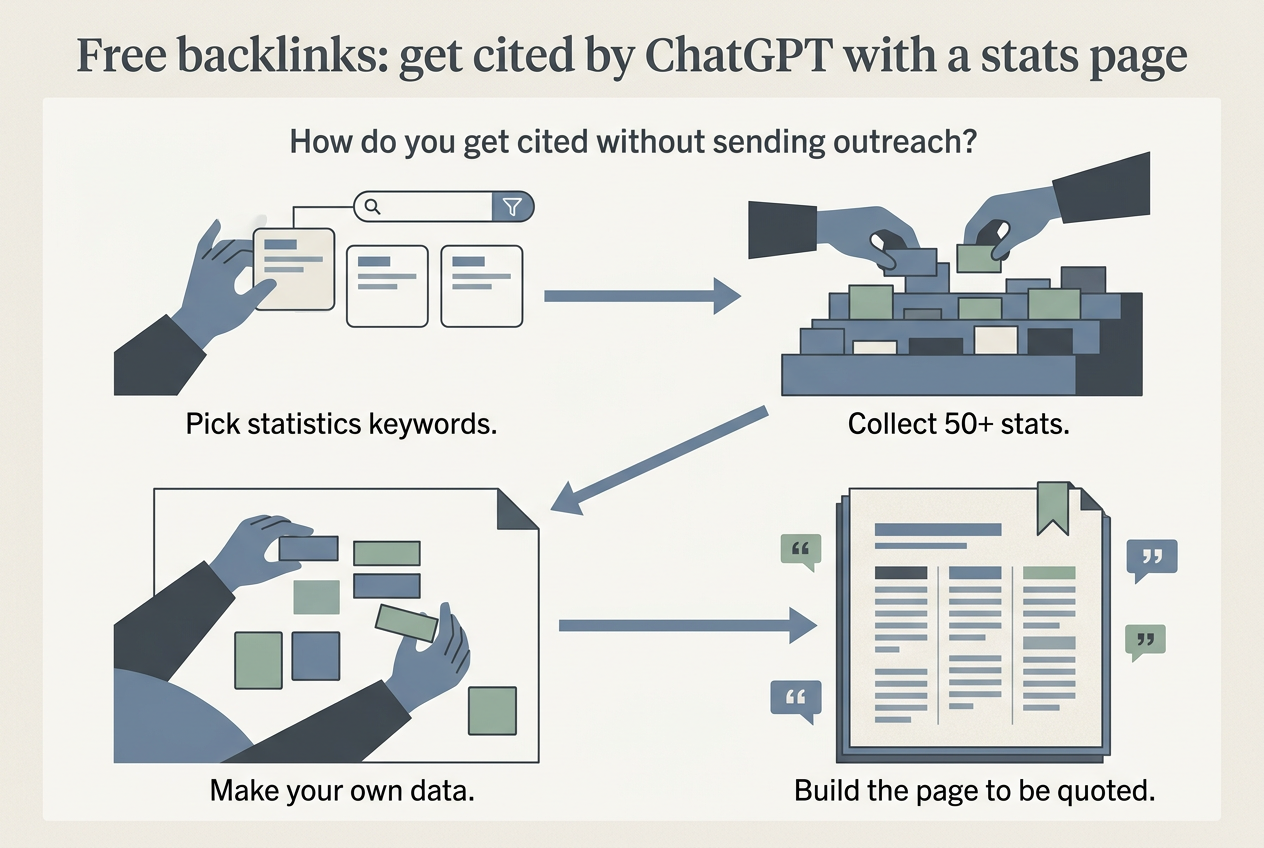
How do you get cited without sending outreach?
You become the source of a number people want to quote, and you make that number easy to find, check and copy.
A reader asked me after my reel: how do I get bloggers and journalists to cite my site without outreach, and ChatGPT too? And what does a stats page that earns links look like, so I can build one? I'll answer both. I made a Telugu reel on this. This post is the written version, with the research I did afterwards to check what I said in it.
One thing first. I can't promise ChatGPT will cite you, and I can't promise links by a certain date. Nobody can. Below, I show what OpenAI and Google themselves say.
Why a writer gives you free backlinks without being asked
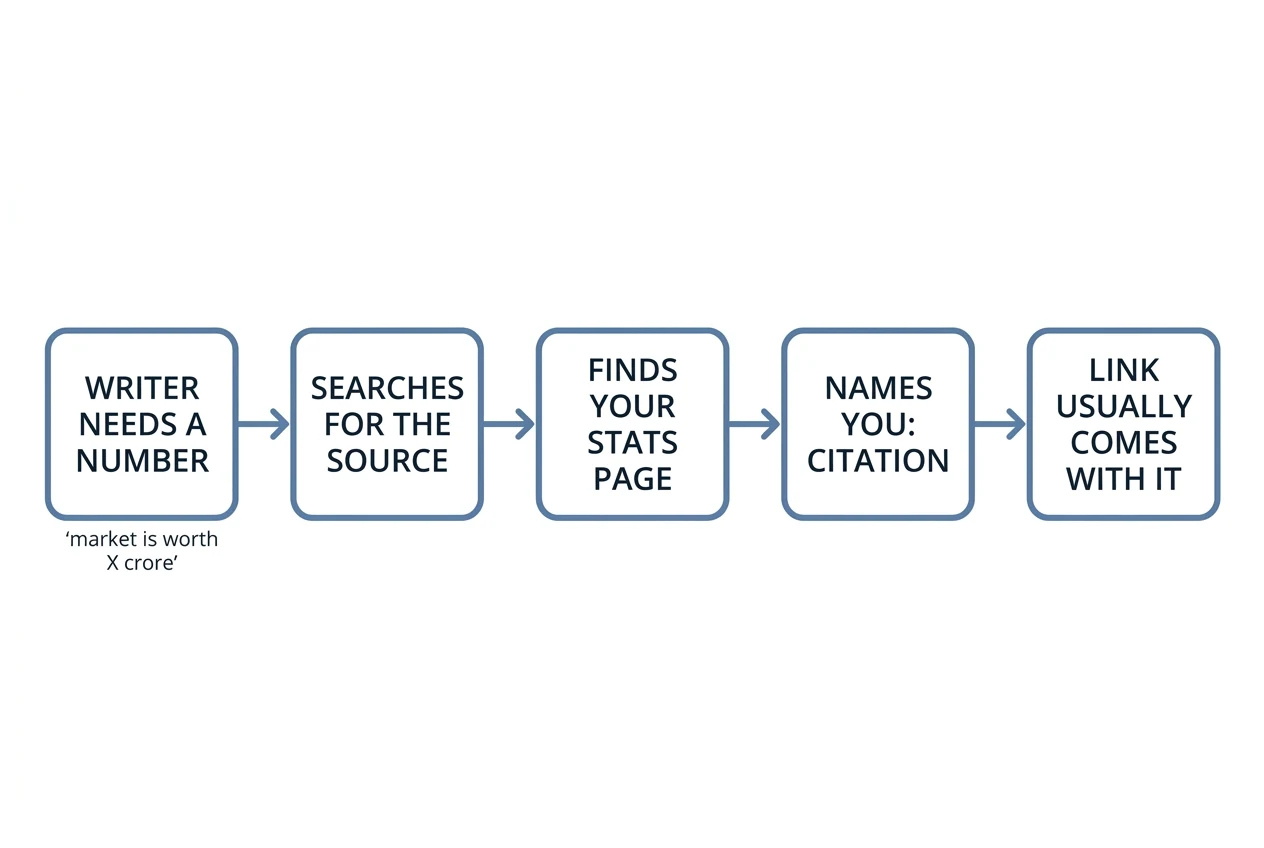
Every blog post, news piece and AI answer has a sentence like "the market is worth X crore" or "Y% of people do this". The writer has to prove it. So they look for the source of that number.
If your page is that source, they name you. That is a citation, and a link usually comes with it.
In the reel I mentioned one founder who got 20 backlinks in four months this way. Some came from DR 82 websites, and there was not one email or form. That is one person's reported result. I haven't checked it myself, and yours will depend on your topic and how good the page is. The playbook behind this, which I'll link at the end, also says its author's own figures were shared on X and not independently verified. I'm giving you the method, not a forecast.
Step 1: pick statistics keywords, not "best software"
"Best software" is what a buyer types. A writer types something else, late at night, when tomorrow's post needs a number: "India digital payment statistics 2026".
So write the page around keywords like these:
- [topic] statistics India 2026
- [topic] market size India
- [topic] complaints statistics
The playbook has a quick check I like. Search your keyword and look at what ranks. If the top results are old, have no sources, or only cover the US, you have an opening.
Step 2: collect 50+ stats from original sources
Collect 50 or more numbers, and take each one only from where it began. Use government reports and company filings, or real research. Don't use another blog's roundup that copied a roundup.
Here is where I'd look for Indian data, and how to cite it. I could not load the NPCI, MoSPI and data.gov.in pages from where I worked. For those I name the place but don't quote any figure. Open them yourself and copy the wording exactly.
| Where | What it holds | What to write down |
|---|---|---|
| RBI | The Payment System Report, which RBI says it will publish twice a year after its first edition in December 2024, and monthly Payment System Indicators | Report name, edition or month, publication date, link |
| NPCI | UPI product statistics | Table name, month, date you read it, link |
| MoSPI | National statistics releases | Release name, reference period, date, link |
| data.gov.in | Open government datasets | Dataset title, the department that owns it, date, link |
| Company filings | Annual reports and exchange filings on BSE and NSE | Company, report year, page number, link to the filing |
Write every source line the same way: who published it, the name of the report, the period the number covers, the date it was published, and the link. Add the date you checked it too. If you can only find the number in a news article, use the article to find the original, then cite the original. If you can't find the original, leave the number out.
Copying numbers by hand also goes wrong. The playbook's advice is to open every source link and confirm the number is on that page before you publish. I agree. It's the whole value of the page.
Step 3: make your own data, which nobody else has
A page of public numbers is useful, but anyone can copy it. The part I like most in the playbook is making a number nobody else has.
The example we used was reviews. For two markets in India, a research tool called Dots (from gcombinator.co) collected public reviews and forum posts about six competitors in each market and sorted them.
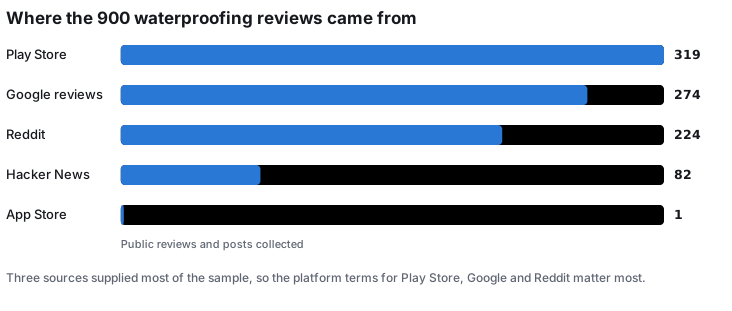
Waterproofing in Hyderabad (report dated 14 Oct 2026)
- 900 public reviews and posts collected, 396 read and tagged one by one
- By source: Play Store 319, Google reviews 274, Reddit 224, Hacker News 82, App Store 1
- 191 one-star reviews and 307 five-star reviews among the 900, and 306 posts with no stars
- 50% of the 396 tagged reviews were anxious (198 reviews), 34% were about value and 16% about motivation
The happy reviewers praised a professional team (the most mentioned topic, 67 reviews, in 48% of the 5★ reviews). They also liked finding the root cause and a clear explanation. The unhappy ones hated a "not registered" error in a contractor app (43 reviews), no response (31 reviews, averaging 1.3★), and product quality.
Wholesale sarees, Andhra Pradesh (report dated 11 Oct 2026)
- 682 reviews and posts collected, 436 tagged
- Reviews that mention fraud or scams average 1.1★, the lowest of any topic
- Reviews about reseller business growth average 4.8★, the highest
These numbers are not market-wide facts, and the report says so itself. The sample deliberately takes at least 100 one-star and 100 five-star reviews where they exist, so it over-represents the extremes. Write it as "50% of 396 sampled reviews", never "50% of customers". That honest wording is what keeps a journalist citing you.
Then pull out what it means. The reviewers' complaints are a to-do list for anyone building in that market. People who need the insight cite you, and people building a product use it.
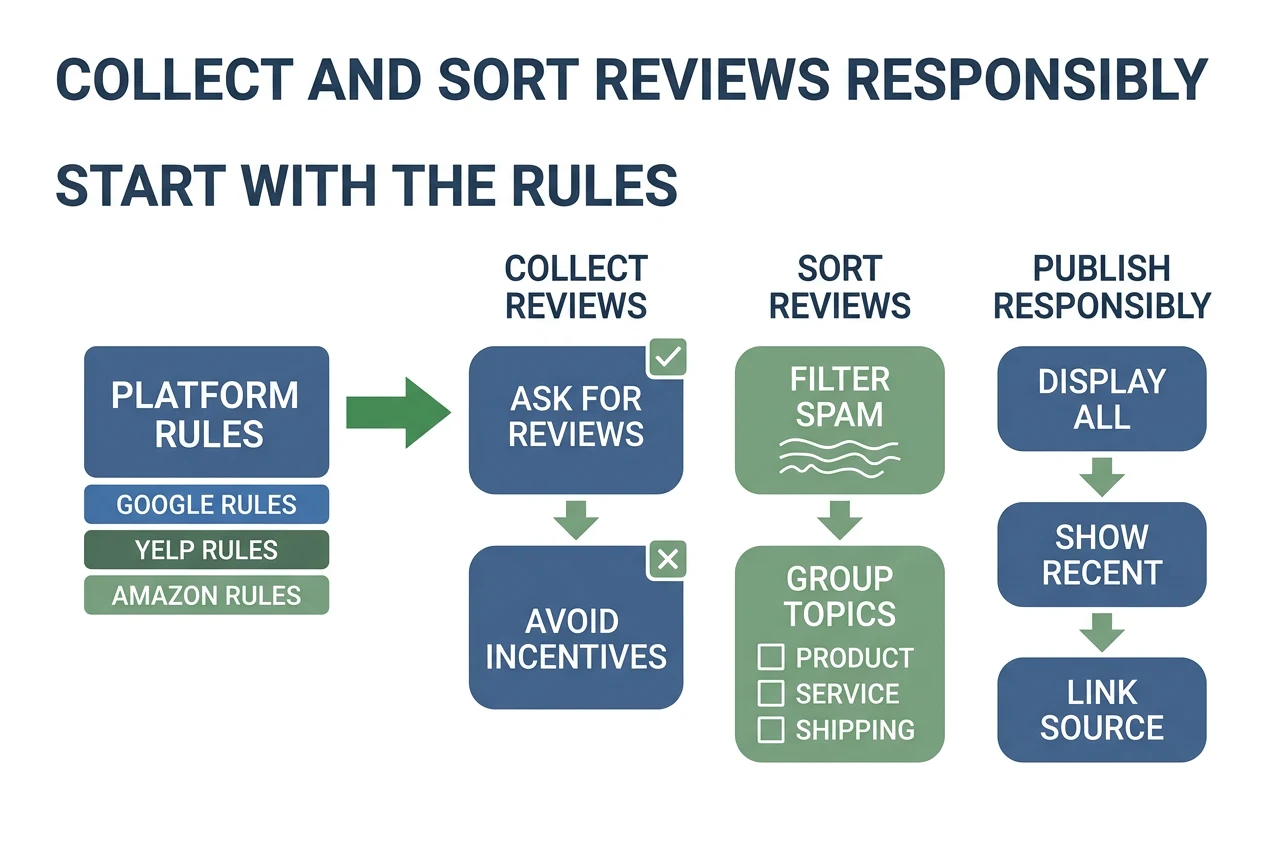
How do you collect and sort reviews responsibly?
Start with the rules, because each platform has its own.
- Reddit. Its Data API terms say commercial use or anything not expressly permitted needs a separate agreement with Reddit. I read this in a search summary of the terms, because I couldn't open Reddit's page. Read it there before you collect anything.
- Google Play. Google's own reviews API lets you read reviews for your own app, with a permission set up in the Play Console. I found nothing in Google's docs that offers the same for other companies' apps. I couldn't open the full Play terms, so read them before you collect competitors' reviews.
- Google Maps reviews. I couldn't load the Maps Platform terms in full. They are the page to read before collecting anything from Maps.
- Hacker News. The public API page says it has no rate limit and states no terms of its own. That doesn't mean there are none, so still read the site's terms.
If a platform's terms don't allow what you want, don't do it. Use your own customers' reviews, or read a small sample by hand.
The method itself is simple, and you can do it in a spreadsheet:
- Collect, and note the source of every review. You need it for your methodology section.
- Pick a sample spread across star ratings, and keep the forum posts that have no stars separate.
- Read each review and tag it with a topic of one to three words. Also note whether it shows motivation (why they want it), value (why this one) or anxiety (what makes them hesitate).
- Count. Every number on your page should be a count of tags.
- Write what you did on the page: the sample size, the sources and the dates.
In the reports, an AI read each review and tagged it, and the counts came from those tags. The wording of the headlines was checked against the counts. If you use an AI for the tagging, spot-check a batch yourself.
Step 4: build the page so it is easy to quote
This is the format I described in the reel:
- The first 10-12 lines are one-line key stats.
- Headings are questions, and the first line under each one is the answer.
- Every stat has a source, a date and a link.
- One stat per line, and each number appears once.
- A "How to cite this page" box with a ready line to copy.
The playbook adds one more: simple charts with your site name on them, because people reuse those.
A writer in a hurry scans the top, finds the number, checks the source line, and moves on. Make each of those steps take seconds.
Does ChatGPT really cite pages like this?
Here is what I can prove. OpenAI's bot documentation says OAI-SearchBot is used to surface websites in ChatGPT's search features, and that sites opted out of it won't be shown in ChatGPT search answers. It recommends allowing OAI-SearchBot in your robots.txt. It does not promise inclusion.
Google's page on AI features says a page has to be indexed and eligible to appear in Search with a snippet to be a supporting link. It also says there are no extra requirements to appear in AI Overviews or AI Mode, and no special optimisations or schema markup needed. It describes a "query fan-out" technique, where the system runs several related searches across subtopics. That fits headings written as questions, but Google doesn't say that's why it works.
So where does that leave a stats page? A page with a clear answer, a dated source and a link is the kind of page those systems can find and a person can verify. I could not find any OpenAI or Google documentation that shows a stats page earns citations. The playbook claims citations in ChatGPT and Perplexity, and in Google AI Overviews. I can't check that claim from their docs. Treat it as something to test.
The playbook's test is simple. Once a month, ask ChatGPT, Perplexity and Google AI Mode your 10 target questions, and see if your page is named.
What DR 82 actually means
DR is Domain Rating, and it is Ahrefs' number, not Google's. Ahrefs' help page says it shows the strength of a site's backlink profile on a scale of 0 to 100. A site splits its rating between the sites it links to. So a link from a site that links out to few others carries more weight.
It is a relative measure of the whole domain, not of a page, and Ahrefs says to judge a link by more than DR. Relevance and traffic count too, and so does content quality. So when someone says "two links from DR 82 sites", read it as a good sign, not as proof of any result.
Mistakes I see on stats pages
- Secondary sources. You quote a blog that quoted a report. Trace it to the original.
- No date, or a fake one. Google's guidance on dates says to show a visible date and to keep it consistent with the date in your page markup. It says the date should reflect when the page was published or updated. Only change it when you've changed something real.
- A stale year in the title. Keep the same URL every year, with no year in it, and change the year in the title and H1 only. Then every link you earned keeps counting.
- No schema. Google says AI features need no special markup. Even so, Article markup with
datePublishedanddateModifiedis how Google suggests you pass on accurate dates. It's cheap to add. - Overclaiming a sample. "50% of sampled reviews" is true. "50% of customers" is not.
Keep it fresh
The playbook suggests a calendar. Check every source link monthly. Swap in newer numbers quarterly, and re-run your own research when the market moves. Change the year yearly. Update the "Last updated" date only when the page really changed.
Your plan for this week
- Write down one topic as "[topic] statistics India 2026".
- Collect 50+ stats from original sources and write the source line for each.
- Decide on one set of your own numbers, and check each platform's terms before you collect.
- Put the key stats in the first 10-12 lines. Make headings questions, and answer each in the first line.
- Allow OAI-SearchBot in robots.txt and add a visible date. Then set a monthly reminder to check your 10 questions in ChatGPT.
Download the Citation Hub playbook
The full step-by-step template is in the PDF. It has the waterproofing and saree examples, a checklist and the prompts.
Keep reading.
Drop your email and the rest of this post opens, along with everything else I write here.
ONE EMAIL, ONCE. NEVER SHARED.
Thanks for reading this far.
I am open to remote growth and Entrepreneur-in-Residence roles in crypto. If any of this was useful, the rest of what I have built is one click away.